



Before it becomes a pendant, a set of backgammon checkers or a smooth chess piece, every piece of Baltic amber passes the sorting table. This is the first and perhaps the most underrated stage of KIZIMA®’s work — here it is decided which stone deserves the workshop bench and which will go to smaller components.
The first look at the stone
Raw amber rarely looks like finished jewelry. It is covered with an oxidized crust, often cloudy and irregular, and only after the first cleaning does it become clear what is hidden inside — from a transparent honey tone to dense, almost opaque areas full of inclusions. At the sorting table the artisan judges the stone by several signs: transparency, richness of color, cracks and inclusions, the size of the piece. An experienced eye needs a few seconds to know whether a fragment will suit a large cabochon, a thin facet of a choker, or a detail of a chess piece.
What is set aside immediately
Not every piece reaches the next stage. Fragments that are too small, cracked or cloudy are put aside — they do not meet the KIZIMA® standard, where not only the authenticity of the stone matters but its visual clarity. Such selection may look wasteful, but it is exactly what separates a piece bought by chance at a market from an object made by hand in Brooklyn to be worn for decades.
From lump to blank
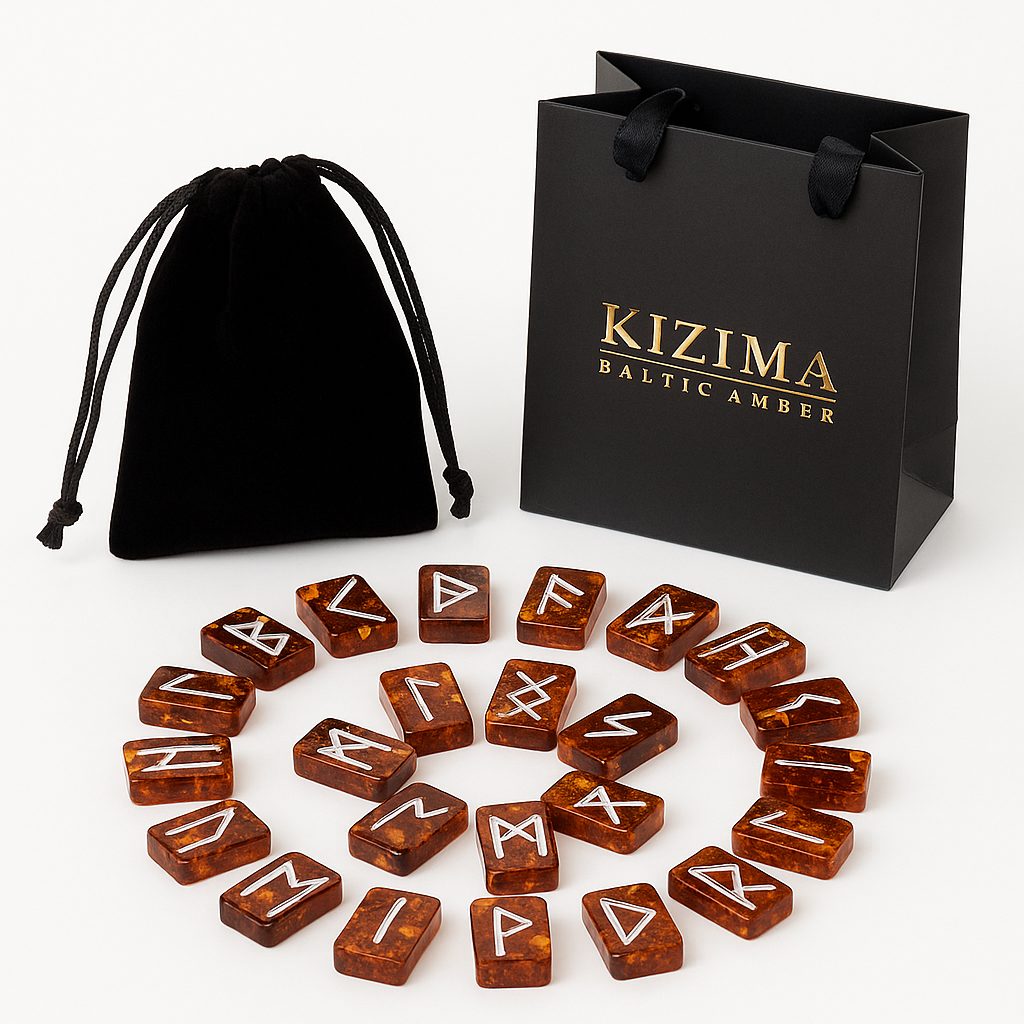
Stones that pass are then grouped by their future purpose — a second sorting within the batch. Large, uniform pieces are reserved for rings and pendants where an even surface matters. Smaller and irregular fragments go to mosaic pieces, rune sets or game pieces, where variety of tone is an advantage. So no worthy piece of amber is left unused.
Why it matters
The quality of the future piece is decided at this stage — long before the cutting disc and the polishing wheel come into play. Sorting takes patience and experience: haste here means risking the workshop’s time on a stone that will not survive working or will split at the final polish. KIZIMA® remains the only manufacturer of Baltic amber products in America partly because it does not cut this step short — every stone gets the attention its origin deserves, and the customer receives a piece without hidden cracks or weak points.
More about handmade pieces in genuine Baltic amber: shop handmade amber jewelry or visit our Brooklyn store — every stone hand-selected in Brooklyn.


