



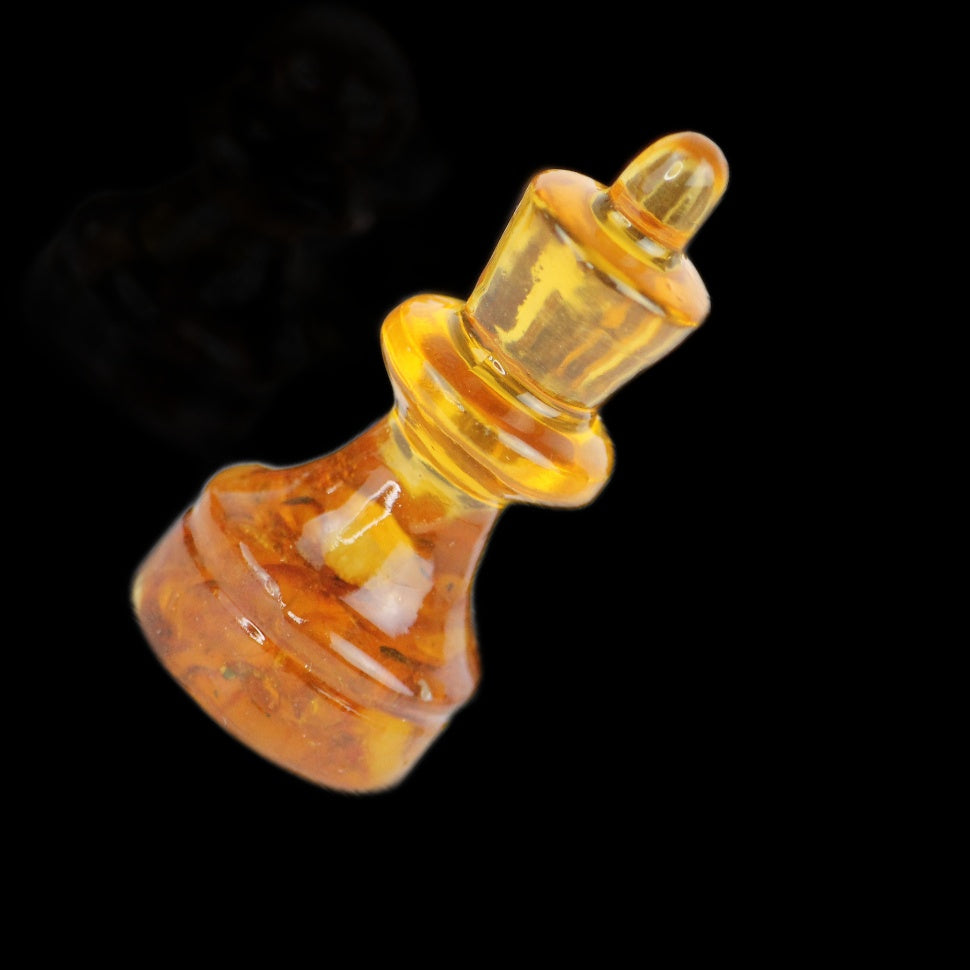
Under a loupe or a strong lamp, a piece of Baltic amber stops looking like a single warm-colored stone and starts looking like a record: clouded bands, trapped air, the occasional fleck of ancient plant matter, each one unrepeatable. That is the view from the cutting bench in KIZIMA®'s Brooklyn workshop, where raw amber becomes chess pieces, jewelry, and game sets, one small cut at a time.
Reading the Stone Before Cutting
Every piece of rough amber is different — in density, in clarity, in the direction of its internal cloudiness — so cutting starts with looking, not cutting. A craftsperson turns the stone under light to find where it is clearest and where it is fragile, then marks a line that works with the material rather than against it. Amber is harder than it looks but also brittle; a cut in the wrong direction can shatter a piece that took weeks to source.
Cutting and Shaping by Hand
The rough shape comes off with small rotary tools and hand files, in short, controlled passes. Amber generates heat quickly under friction and can scorch or crack if pushed too fast, so the pace is unhurried by design — closer to stone-cutting than to production-line woodworking. A single chess piece or pendant blank can take a number of separate cutting and shaping passes before its final silhouette even emerges.
The Polish That Reveals the Stone
Polishing is where the amber actually shows what it is. Coarse abrasives remove tool marks first, then progressively finer ones bring up the shine, coat by coat, until the surface reflects light cleanly and the interior — the bands, the clarity, the color — becomes visible rather than just implied. This last stage is done slowly and checked often, since amber can be over-polished into a flat, glassy look that loses the texture that makes each piece recognizable as genuine, natural stone.
Why No Two Pieces Match
Because every piece of rough amber cuts differently, no two finished pieces — even from the same set — come out identical. That is not a limitation of hand work; it is the point of it. A close-up look at any KIZIMA® piece is really a close-up look at the Baltic Sea coast, 44 million years removed.
See more of the process and the finished pieces at kizima.us.


