



The Amber Book — Chapter 9
Somewhere — in a forgotten mine, a sealed bunker, or nowhere at all — lies the most famous missing artwork on Earth: an entire room made of amber. Its story has everything: kings, war, obsession, and six tons of frozen sunlight.
A gift between giants
The Amber Room began in Prussia around 1701, conceived for the Berlin palaces — wall panels of carved amber mosaic, backed with gold leaf, glowing like the inside of a jewel. In 1716 the Prussian king presented the panels to Peter the Great of Russia to seal their alliance. The Tsar sent soldiers in return; the king sent a room. History records no stranger exchange of gifts.
The eighth wonder
Under Empress Elizabeth and Catherine the Great, Russian and Italian masters enlarged the room in the Catherine Palace near St. Petersburg into something beyond imagining: over 55 square meters of amber panels, six tons of Baltic amber, gilded carving, mirrors, and Florentine stone mosaics. Candlelight turned the walls to living honey. Visitors called it the eighth wonder of the world, and no one argued.
The disappearance
In 1941, German forces dismantled the room in 36 hours and shipped it — with grim symmetry — to Königsberg, the city where amber craft was born. It was displayed in the castle there until 1944. Then the war closed in: bombing, fire, siege. After 1945 the Amber Room was simply… gone. Burned in the castle, say some. Hidden in tunnels, buried in a mine, sunk with a ship, say others. Treasure hunters have searched for eighty years. Not one confirmed panel has surfaced.
The resurrection
Russia chose the only answer worthy of the loss: craftsmen spent 24 years — longer than the original took — rebuilding the room from photographs and rediscovered guild techniques, completing it in 2003. The reconstruction in the Catherine Palace proves something quietly wonderful: the knowledge of the old amber masters can be reborn in new hands.
Why we tell this story
The Amber Room is the north star of every amber workshop, ours included. It says: this material is worthy of palaces, of decades of labor, of legend. When we carve a chess set or an icon panel in Brooklyn, we work in the long shadow of that glowing room — and we like the light there.
Next chapter: amber at the courts of Europe — the diplomacy of gifts.
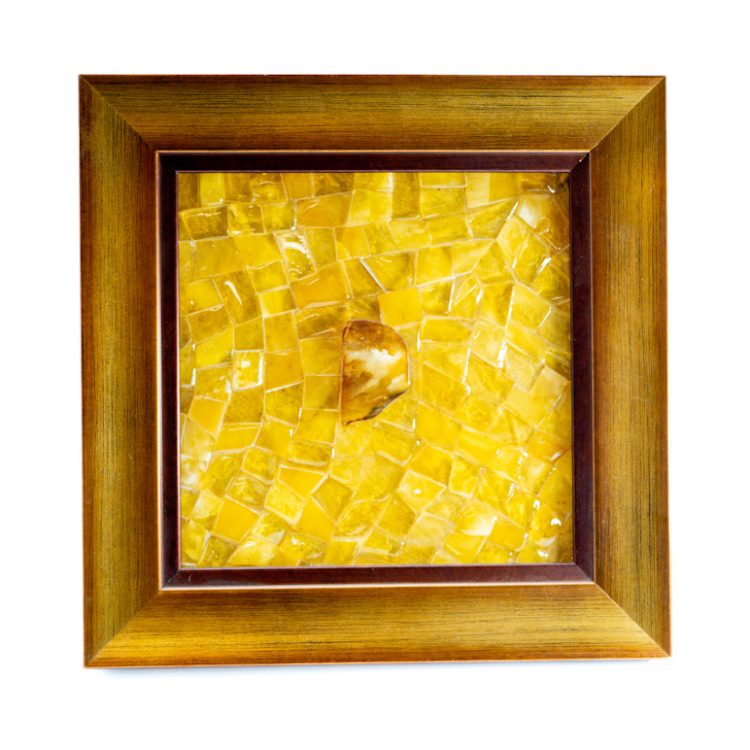
Bring the wonder home with amber wall art panels inspired by the legendary Amber Room. Explore amber jewelry.


